Why Punjabi Kitchens Have Always Trusted Mustard Oil — And Why Science Now Agree
- 21 May 2026
Why Punjabi Kitchens Have Always Trusted Mustard Oil — And Why Science Now Agree
From your naani's wok to modern nutrition research — the golden oil that never needed a rebrand.
Walk into any traditional Punjabi kitchen — in Ludhiana, Amritsar, Jalandhar, or a village off the GT Road — and before you see anything, you'll smell it. That sharp, bold, unmistakable aroma rising from a hot tawa. That is mustard oil doing what it has always done: announcing itself with absolute confidence.
No other oil does this. Refined oils are silent. Olive oil whispers. Mustard oil speaks in full sentences.
For decades, this pungent confidence was seen as a problem to be refined away. International markets banned it. Nutrition labels called it questionable. And yet, in homes across Punjab, grandmothers kept reaching for the same yellow tin — because they knew something the packaging did not say.
Mustard oil was never a backward choice. It was always the right one — we just lacked the science to prove it.
Mustard oil, pressed from Brassica juncea seeds, has a nutritional profile that modern dietitians now study with genuine interest. It contains a favourable ratio of omega-3 to omega-6 fatty acids, rich monounsaturated fats, low saturated fats, and allyl isothiocyanate — the compound responsible for its pungency and antimicrobial properties.
Nutritional snapshot per tablespoon:
• 60% Monounsaturated fatty acids (MUFA)
• 21% Polyunsaturated fatty acids (PUFA)
• 12% Saturated fats
Its smoke point of around 250°C helps it stay stable during high-heat North Indian cooking.
Punjab's connection with mustard oil goes beyond taste. It has long been part of practical daily life — warming winter food, massaging newborns, preserving pickles, and supporting traditional cooking methods.
Traditional uses include:
• Infant massage oil
• Achaar preservation
• Tadka for dal
• Hair oil during winters
• Traditional joint massage
Mustard oil contains erucic acid, which raised concerns in older animal studies. However, Indian food authorities recognise mustard oil as safe for consumption, and long-term consumption patterns in India have not shown the predicted cardiovascular risks.
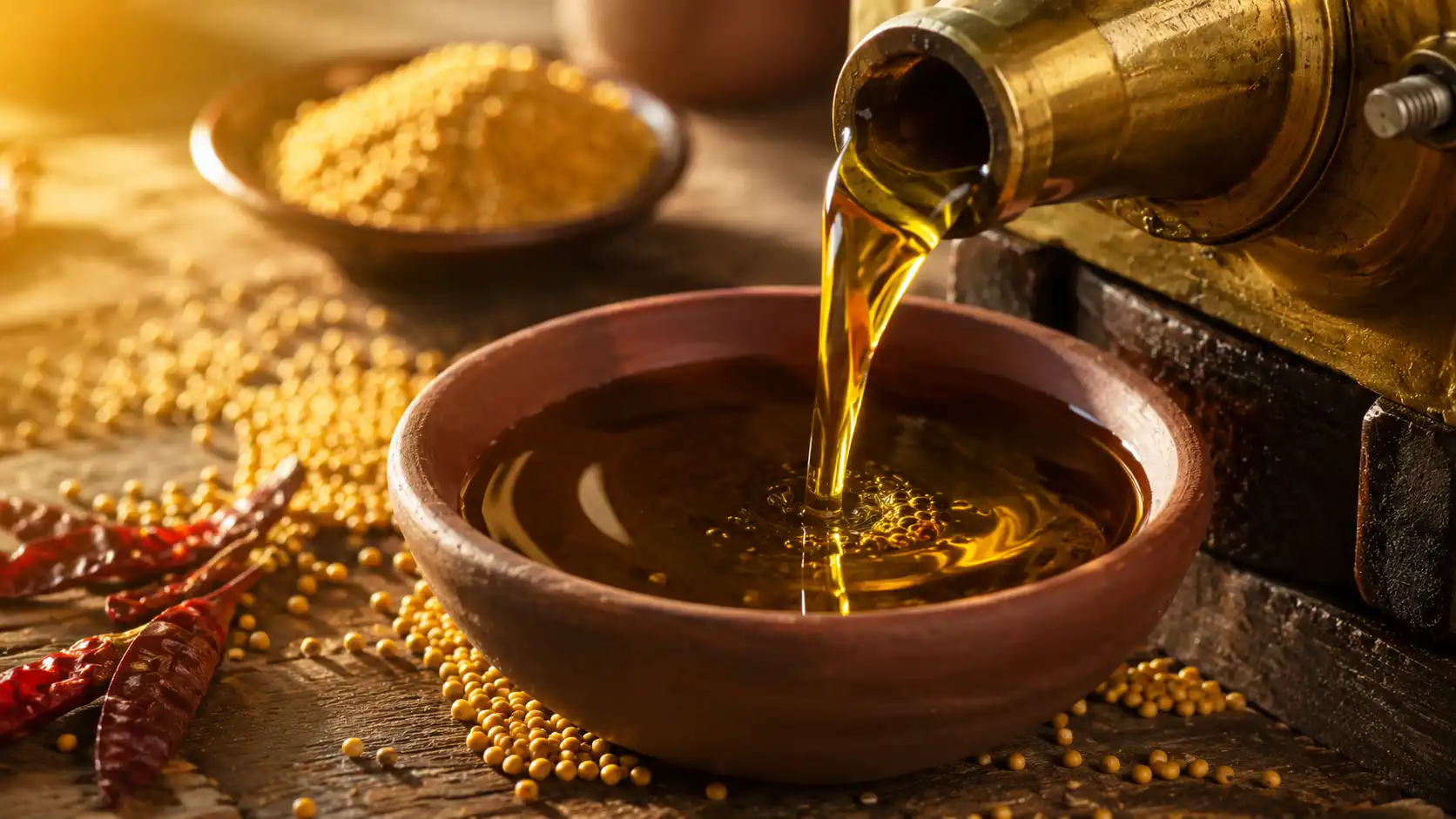
Kachi Ghani cold-pressed extraction preserves antioxidants, volatile compounds, and natural pungency better than heat processing.
MORE Mustard Oil follows this traditional process because purity comes from method, not marketing.
For cooking, mustard oil is traditionally heated until smoking before adding ingredients. This mellows raw pungency and creates the familiar depth associated with Punjabi cuisine.
In a market full of complex ingredient lists and health claims, mustard oil remains simple — trusted through generations.
The real question is not just what the label says.
It is what the kitchen says.
And kitchens across Punjab have been giving the same answer for decades — pure taste, every time.