The Achaar Secret That Every Punjabi Nani Knew — And Modern Science Is Finally Catching Up To
- 21 May 2026
The Achaar Secret That Every Punjabi Nani Knew — And Modern Science Is Finally Catching Up To
Why mustard oil has preserved flavour, health, and memory in Indian homes for centuries — and why no substitute has ever come close.
Walk into the home of anyone who grew up in a Punjabi household and ask them what smell they associate most with their nani's kitchen. The answers will vary — haldi, cardamom, woodsmoke. But somewhere in that list, almost always, is achaar. And behind every great achaar is mustard oil.
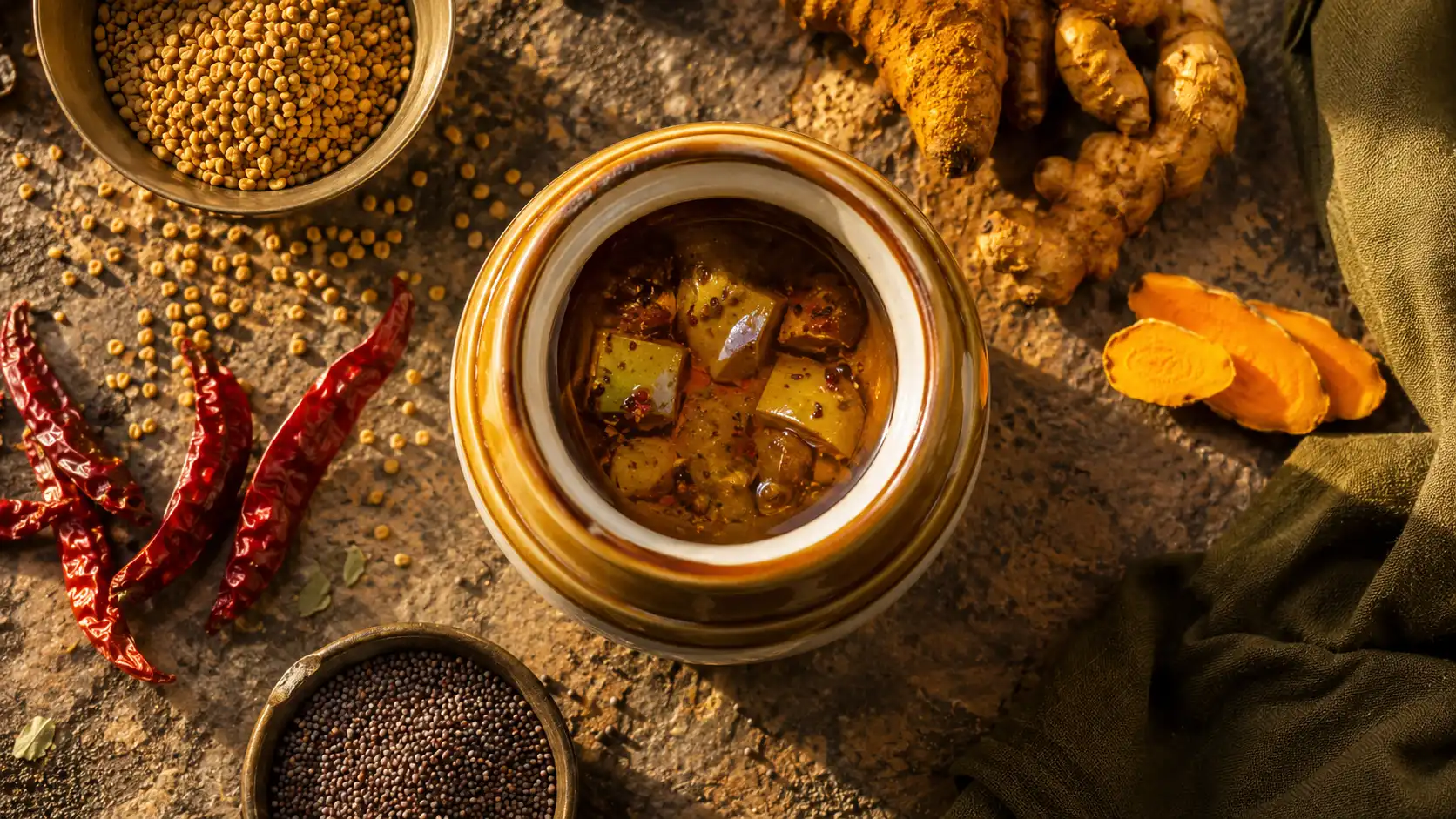
Not refined oil. Not sunflower oil. Mustard oil — sharp, golden, unapologetic — poured generously over salted, spiced vegetables and left to work its slow, patient magic in a clay or glass jar sitting in a sunny windowsill.
This was not a recipe. It was a system. And it worked so reliably, for so many generations, that it was simply never questioned.
Now, it does not need to be questioned. It needs to be understood.
Why Achaar and Mustard Oil Are Inseparable
The pairing of achaar and mustard oil is not cultural coincidence. It is chemistry.
Mustard oil contains allyl isothiocyanate — the pungent compound that gives it its distinctive heat. This same compound has documented antimicrobial properties. It inhibits the growth of bacteria, molds, and yeasts — the exact organisms that would otherwise spoil a jar of salted vegetables within days.
Before refrigeration. Before preservatives. Before vacuum packaging. Mustard oil was the technology that made year-round preservation possible in Indian homes.
Your nani was not following a tradition blindly. She was running a remarkably effective preservation system using an ingredient she had complete trust in — because it had earned that trust, season after season, jar after jar.
The Art of the Sun — What Slow Fermentation Actually Does
The process of making achaar in a traditional Punjabi home is deceptively simple: vegetables are salted, spiced, submerged in mustard oil, sealed loosely, and placed in direct sunlight for days or weeks.
What happens during that time is far from simple.
The salt draws moisture from the vegetables, creating a brine. The spices — mustard seeds, fenugreek, dried chilies, turmeric — contribute their own antimicrobial and antioxidant compounds. The mustard oil acts simultaneously as a carrier, a preservative, and a flavour vehicle, pulling the volatile compounds from every spice and integrating them slowly into a unified, complex taste that no commercial recipe can replicate in 24 hours.
The sunlight accelerates fermentation just enough. The result — after patience — is a jar of achaar that will last a year, deepen in flavour every month, and taste unlike anything you will buy in a store.
This is not nostalgia speaking. This is a process that genuinely produces a superior result, and mustard oil is the reason it works.
What Happens When You Substitute the Oil
This is worth saying plainly, because many modern kitchens have tried.
Refined sunflower oil, soybean oil, or vegetable oil can technically be used to make achaar. The result will look similar for the first few weeks. But the antimicrobial protection is significantly weaker. The flavour integration is shallower — the spices sit in the oil rather than becoming the oil. And the shelf life, without refrigeration, is dramatically shorter.
More importantly, the taste is different in ways that are hard to articulate but immediately obvious. Mustard oil does not just preserve achaar. It transforms it. The oil itself becomes part of the final flavour — rounded, deep, warm, with that characteristic background heat that lingers pleasantly.
There is a reason your mother could tell, from one bite, whether achaar was made with "asli sarson ka tel" or something else. It was not imagination. It was taste memory — accurate, and correct.
The Three Achaar Every Punjabi Kitchen Should Have
Gobhi-Shalgam-Gajar (Winter Pickle) The classic cold-weather achaar. Cauliflower, turnip, and carrot — cut large, salted overnight, then packed with mustard seeds, ajwain, red chili, and submerged in warmed mustard oil. Ready in 4–5 days of winter sun. This is the one that appears on the breakfast table next to paratha and dahi, and makes every morning feel complete.
Aam Ka Achaar (Raw Mango Pickle) Made in the brief window when raw mangoes are available — April and May in Punjab. Cut thick, packed with fennel, fenugreek, nigella seeds, and turmeric, then covered generously in mustard oil. This is the pickle that travels — in tiffins, in bags to college hostels, in parcels sent to relatives in other cities. It carries home with it.
Mirchi Ka Achaar (Green Chili Pickle) Stuffed with a dry spice mix and set in mustard oil, these chilies mellow over weeks into something that is intensely flavourful rather than simply hot. One piece alongside any simple dal-roti meal transforms it entirely.
All three rely on the same foundation: good mustard oil, patience, and sunlight. The more generous you are with the first, the better the result.
Why MORE Mustard Oil for Your Achaar
The quality of mustard oil used in achaar matters more than in almost any other application — because the oil is not just a cooking medium here. It is an ingredient. It goes into the jar raw and comes out, months later, as part of the flavour itself.
Cold-pressed mustard oil — the kind produced carefully without excessive heat — retains the natural pungency, the allyl isothiocyanate content, and the complex background notes that make the difference between achaar that tastes homemade and achaar that tastes like a factory produced it.
Since 1981, MORE has been pressing oil the way it should be pressed. The families across Punjab who have trusted this brand for over four decades did not do so because of marketing. They did so because the achaar turned out right, every single time.
That is the only review that has ever mattered.
One Last Thing About Preservation
There is something that mustard oil preserves beyond vegetables and spices.
Every jar of achaar made at home carries the particular spice ratios and technique of the person who made it. Those proportions are rarely written down. They are learned by watching, tasting, adjusting — and then, eventually, by doing it yourself and realising that your version tastes almost, but not quite, like hers did.
The pursuit of that taste is what keeps the tradition alive.
Mustard oil is what makes that tradition worth pursuing.
MORE Mustard Oil — Pure Taste. Trusted Tradition. Since 1981. Available in 475ml, 950ml, 1900ml, and 4750ml.