

You Have Been Cooking on the Wrong Oil — Here Is What Forty Years of Punjabi Kitchens Got Right
- 21 May 2026
You Have Been Cooking on the Wrong Oil — Here Is What Forty Years of Punjabi Kitchens Got Right
The quiet, unglamorous truth about what happens to cooking oil under heat — and why the oil your grandmother used was never the problem.
Somewhere in the last thirty years, Indian kitchens were convinced to make a swap. Out went the mustard oil — too pungent, too old-fashioned, too bold. In came refined oils — light, odourless, modern. The packaging was cleaner. The marketing was confident. The price, often, was lower.
It felt like an upgrade.
It was not.
This is not a sentimental argument for tradition over progress. This is about what actually happens inside a hot pan — and why the oil that seemed outdated was, by almost every meaningful measure, the better choice all along.
The Question Nobody Asked on the Label
When you pour oil into a hot pan, you are not just adding fat to food. You are starting a chemical process. And the most important question to ask about any cooking oil is not: how does it taste cold? It is: what does it become under heat?
Every oil has a smoke point — the temperature at which it begins to break down, oxidise, and release compounds that are neither flavourful nor good for you. Beyond that point, the oil is not just degraded. It is actively producing aldehydes, free radicals, and trans fatty acids — the very things that decades of nutrition research have linked to inflammation and cardiovascular stress.
Refined vegetable oils — the ones that replaced mustard oil in many modern Indian kitchens — have smoke points that sound reassuringly high on paper. But refining also strips out the natural antioxidants that protect an oil from oxidative damage. The result is an oil that may technically withstand heat but has little natural defence against the chemical changes that heat triggers.
Mustard oil's smoke point sits at approximately 250°C. More importantly, its natural composition — the allyl isothiocyanate, the tocopherols, the favourable fatty acid profile — means it is genuinely stable at the temperatures Indian cooking demands. It does not just survive the heat. It handles it.
What "Refined" Actually Means
The word refined sounds like an improvement. In oil processing, it describes something more complicated.
Crude vegetable oil — extracted from seeds — contains free fatty acids, natural pigments, waxes, and volatile compounds. Some of these affect flavour. Some affect shelf life. Refining removes them through a sequence of processes: degumming, neutralisation, bleaching, and deodorisation, the last of which uses steam at temperatures between 240°C and 270°C.
What emerges is an oil that is neutral in colour, odour, and taste. It is also largely stripped of the naturally occurring antioxidants — vitamin E, polyphenols — that gave the original oil its stability and part of its nutritional value.
You are left with a product that is easier to sell — consistent, inoffensive, long shelf life — but nutritionally hollowed out compared to what the seed originally contained.
Cold-pressed mustard oil goes through none of this. The seed is pressed. The oil comes out. What is in the seed is in the bottle.
The Fatty Acid Argument — Made Simply
Nutrition science around dietary fats has shifted considerably over the past two decades, and the direction of that shift favours mustard oil.
The ratio of omega-6 to omega-3 fatty acids in a diet matters. Most modern diets — and most refined cooking oils — are heavily skewed toward omega-6, which in excess is associated with pro-inflammatory pathways. The ideal ratio is somewhere between 4:1 and 1:1. Mustard oil sits at approximately 2:1. Sunflower oil sits at roughly 40:1. Soybean oil at around 7:1.
This is not a small difference. And for households that cook with the same oil every single day — as most Indian families do — the cumulative effect of that ratio over months and years is not trivial.
Mustard oil is also rich in monounsaturated fats, which have a well-documented association with cardiovascular health. It is low in saturated fats. And unlike many plant oils, it contains a meaningful amount of alpha-linolenic acid — the plant form of omega-3.
The oil your grandmother used was, from a fatty acid standpoint, closer to what nutritionists now recommend than most of what replaced it.
The Specific Demands of Indian Cooking
This matters because Indian cooking is not gentle.
A proper tadka involves oil heated until it shimmers, sometimes smokes briefly, before mustard seeds are added and the temperature spikes further with their contact. A paratha requires sustained high heat to develop the right crust. A bhuna requires oil hot enough to fry spice pastes without them turning bitter or steaming.
These techniques demand an oil that can withstand real heat without degrading into something harmful. Mustard oil was developed — through centuries of use, not laboratory testing — in exactly the kitchens where these techniques were born. The pairing is not coincidental. It is functional.
Lighter, more delicate oils — including many that are marketed for Indian cooking — are genuinely less suited to these methods. They perform acceptably. They do not perform optimally.
The One Thing You Should Do Differently
If you are using mustard oil and not heating it to its smoke point before cooking, you are missing one of its most important properties.
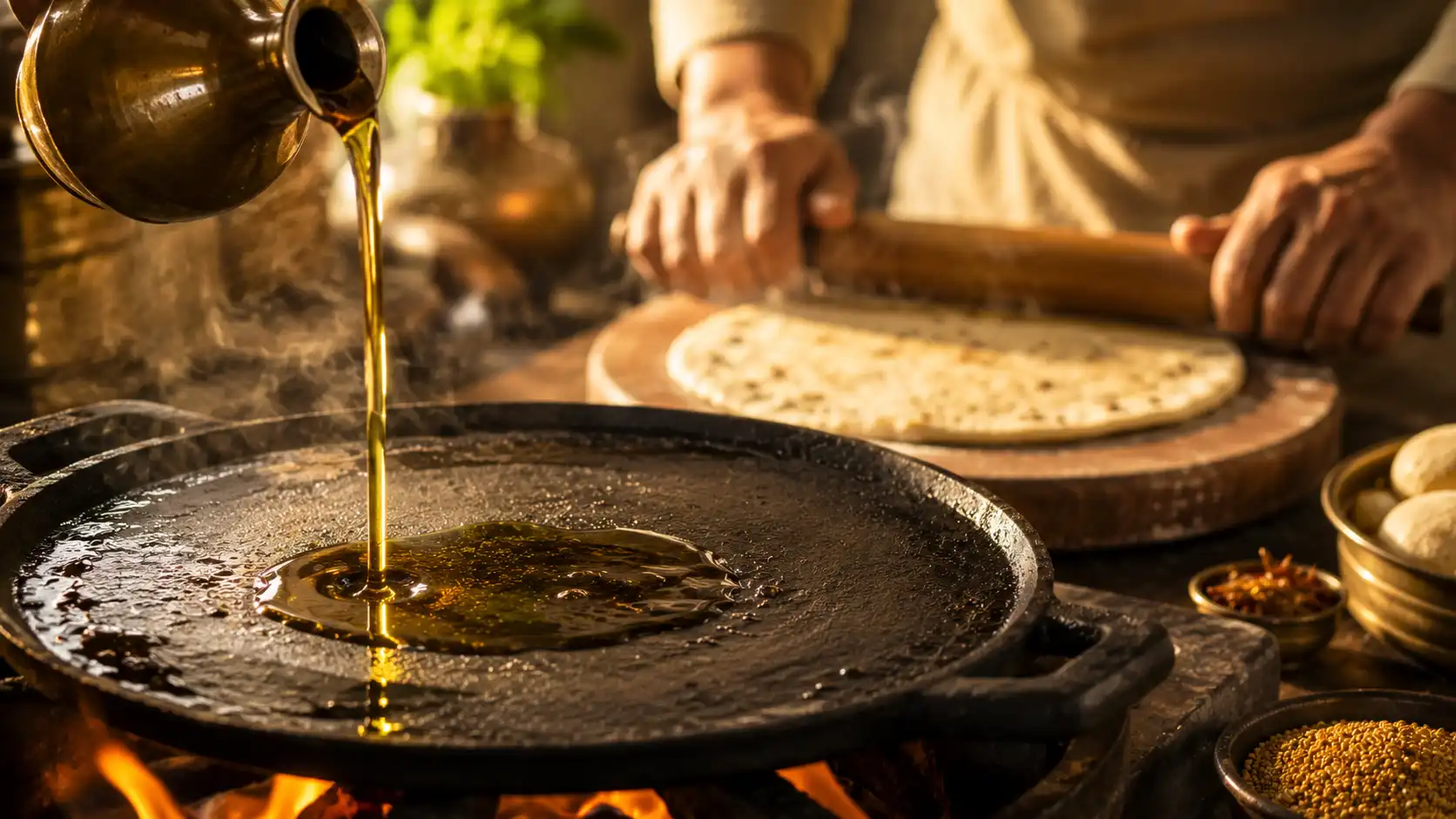
Raw mustard oil has a sharp, intense flavour that not everyone finds immediately appealing. But mustard oil that has been briefly heated to smoking — what many Punjabi cooks call taking it through "ek ubal" — undergoes a transformation. The most volatile and pungent compounds disperse. What remains is a warm, rounded, distinctively nutty depth that elevates every ingredient it touches.
This is not a trick. It is basic chemistry. And it is the reason mustard oil tastes so different in a restaurant paratha versus straight from the bottle.
Heat it first. Then cook. The difference is not subtle.
What Forty Years Looks Like
MORE Mustard Oil has been in Punjabi kitchens since 1981. That is not a marketing figure — it is a simple fact about time and trust. The families who have used it across four decades were not making their cooking choices based on omega-3 ratios or smoke point data. They were making them based on results: flavour that was recognisable and reliable, food that tasted the way food was supposed to taste, an oil that behaved the way they expected it to behave.
The nutrition science has since caught up to what those kitchens already knew. That is rarely how the story goes — usually science leads and habits follow. With mustard oil, it went the other way.
The kitchens were right. The science confirmed it. The only question now is whether your kitchen has made its way back to what it probably already knew.
A Simple Test
Try this once. Take a small steel kadai. Pour in two tablespoons of MORE Mustard Oil. Heat it until you see the first wisp of smoke, then immediately lower the flame and add a pinch of hing and half a teaspoon of jeera.
What happens in the next ten seconds — the bloom of aroma, the particular sizzle, the way the kitchen suddenly smells like a meal worth sitting down for — is not something any refined oil produces in quite the same way.
Some things are difficult to argue with.
MORE Mustard Oil — Pure Taste. Trusted Tradition. Since 1981. Available in 475ml, 950ml, 1900ml, and 4750ml. Explore our products at moremustardoil.com